


Summary
A slot plan is a compromise between conflicting objectives. Peak changes how you should prioritize them.
A slot plan balances objectives that push in opposite directions: picking walk distance, aisle congestion, pick-to-pallet stackability rules and replenishment effort, all inside fixed compliance limits. Most slot plans prioritize walk distance, which is the right call at normal volumes. In peak you put more pickers into the same aisles, waiting time grows fast, and picks per hour per person drops. The fix is to raise the weight on congestion before peak starts.
Peak season in warehousing
Black Friday, Cyber Monday, the holiday shopping rush, back-to-school season. These are some of the periods when warehouses face heightened volumes in orders.
Delays, stockouts, mis-picks, and space constraints become more common as order volumes spike. For warehouse managers, the challenge is maintaining performance and fulfilling orders on time, all while dealing with limited resources and little room for error.
Therefore peak periods demand preparation.
What is a slot plan optimizing, and what should change in peak?
Hopefully more than one thing. Basic slotting optimizers only look at walk distance. In a proper warehouse slotting tool, every slot assignment is a compromise across at least five objectives, and improving one can come at the expense of another.
Three of them should carry a different weight in peak than they do in a normal week.
- Picking walk distance. High in a normal week, medium in peak. The classic objective. Pull the fast movers close together and close to inbound or outbound, and the average pick route gets shorter. Still important in peak, but waiting time now costs more than walking time.
- Congestion. Low in a normal week, high in peak. How many people end up in the same aisle at the same moment. This one moves in the opposite direction to walk distance, because concentrating demand and picks is exactly what shortens the walk. More pickers in a fixed number of aisles means interference starts to dominate.
- Replenishment effort. Medium in a normal week, high in peak. A slot that minimizes picker walking can double the number of replenishment trips. You have moved the costly labor to a different process, not removed it.
- Stackability and pack quality. Unchanged. If the pick sequence has to build a stable pallet, heavy and rigid items need to be picked first. That constrains where they can sit, regardless of how fast they move.
- Compliance and physical constraints. Always high. Flammable goods under sprinkler installations, temperature zones, weight limits per level. These are not weights in the trade-off. They are hard constraints and come first.
Any tool that hands you a slot plan without telling you which objective it weighted highest is hiding the choice from you. The useful question is not "what is the optimal slot plan". It is "what did we optimize for, and is that still the right thing in November?"
Look at what the big platforms publish. Manhattan Associates describes its slotting optimization as working from item velocity, physical characteristics, order affinity and ergonomics. Blue Yonder's advanced slotting forecasts demand to cut pick travel time and maximize fill rates. That input set is right for a normal week. What it does not consider is how many pickers are in that aisle at 10:00 on Black Friday.
Why does congestion explode in peak instead of just rising with volume?
Because you respond to volume by adding pickers, and pickers interfere with each other.
Soondo Hong, Andrew Johnson and Brett Peters put it plainly in their analysis of picker blocking in narrow-aisle batch picking: "when more pickers are included in the picking process, order picking performance is likely to decline due to significant picker blocking." Volume goes up in a straight line. Interference does not.
Rising volume releases two forces that push in opposite directions.
- Congestion pushes productivity down. More volume means more pickers in the same fixed number of aisles, so blocking and waiting time rise.
- Pick density pushes productivity up. More volume also means more lines per batch and more picks in every aisle you visit, so average walk distance per pick drops.
Which force wins depends on your layout and your order profile. You cannot work this out in a spreadsheet, because both forces are non-linear and they interact.
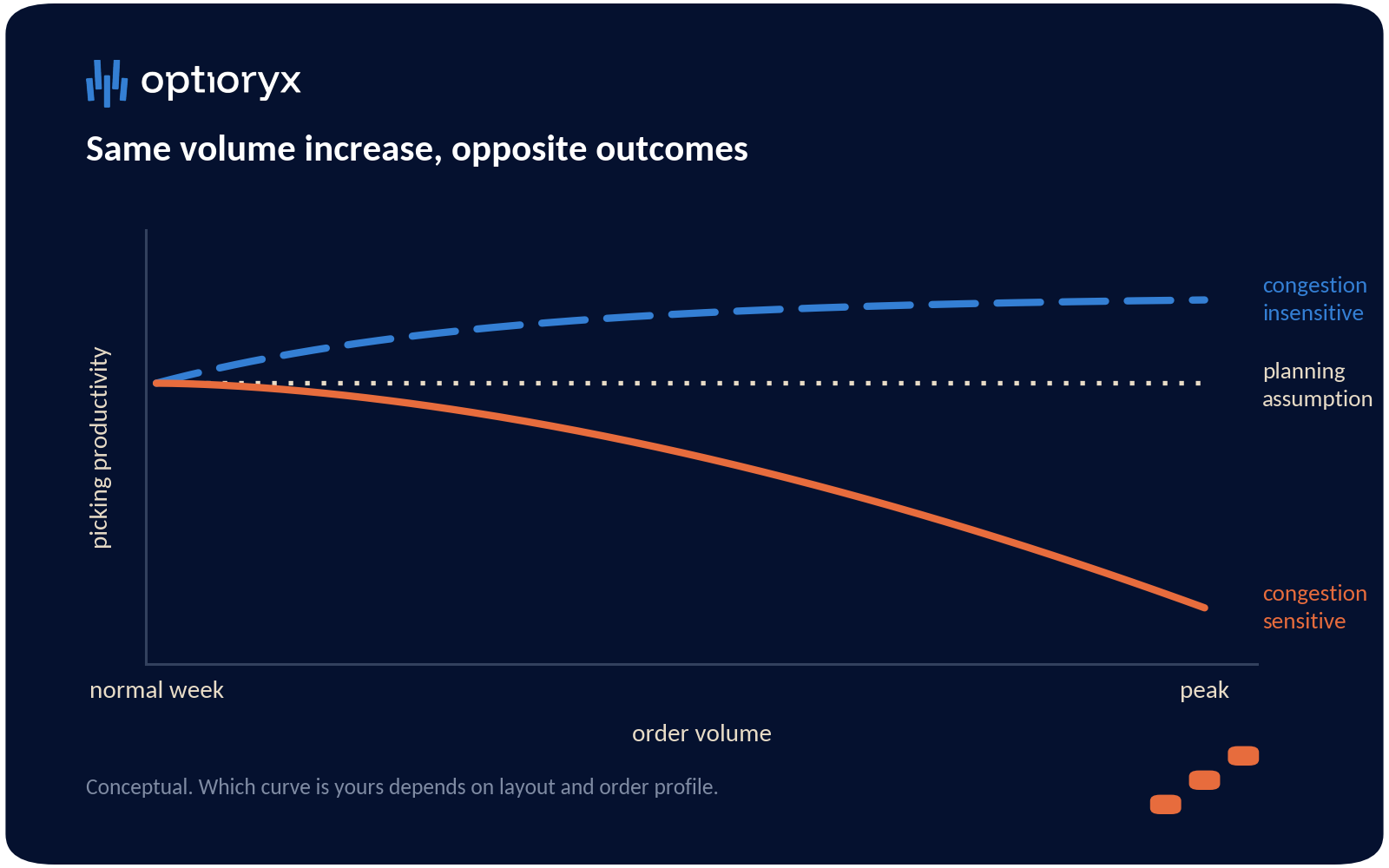
This is what a warehouse digital twin is for, and it is a standard part of a warehouse profiling exercise. Run your real order profile at 150, 200 and 250 percent of a normal week. That gives you the number that matters: picking productivity per demand level, which is what you need to size the picker headcount.
When the downward force wins, three mechanisms do the damage, and they are worth separating.
- In-aisle blocking. In a narrow aisle a picker cannot pass a colleague who has stopped at a pick face, so the one behind waits. Each event costs seconds.
- Pick-face blocking. Two pickers need the same location at the same time. This one does not care how wide your aisle is. Pratik Parikh measured it for wide-aisle systems in the Virginia Tech dissertation the work came out of, which kills the usual objection that wide aisles make you immune.
- Uneven work across aisles. The same Texas A&M line of work found that high variation in picks per trip produces more severe blocking, while low variation keeps blocking low even when pick density is high. Unevenness is the cause, not the busy pickers.
No WMS I have seen reports this as lost time. It shows up as picks per hour going down while headcount drifts up, which is why it usually gets blamed on temp workers.
What changes in the slot plan when congestion gets a bigger weight?
The goal is not to abandon SKU velocity. It is to accept a slightly longer average trip in exchange for far less standing still.
Five moves do most of the work.
- Spread the top movers over more aisles. Concentrating every fast mover into the same block of aisles is exactly what creates the traffic.
- Balance forecast picks per aisle, not just distance. Use the peak forecast, not the annual one. A product that is C-velocity in June can be your number three line in November.
- Duplicate the extreme movers. For the handful of SKUs in a very large share of orders, consider more than one location per SKU. A second pick face in another zone buys parallel picking, at the cost of more replenishment trips.
- Re-check your affinity groups. Affinity slotting reduces distance per order, and it also puts pickers working similar orders in the same place at the same time.
- Leave gaps between the most-visited pick faces. Slow or empty locations between fast movers spread the stops along the aisle, so two pickers are less likely to end up slowing each other down.
Fix your batching
Slotting sets the scene. Batching decides which orders travel together, and that decides how many pickers end up in the same aisle. It is also the faster lever.
The Texas A&M work compared batching methods and found that a near-optimal distance-based algorithm produced very little blocking, while a common seed-based method caused heavy congestion and much longer total retrieval times, in the same layout with the same storage policy.
The order of levers in peak is:
- Slotting first. It is the foundation, and it is slow and difficult to change once peak has started. Which is why it needs looking at in September, not in November.
- Order clustering and batching second. Deciding which orders travel together directly controls how many pickers are in the same aisle at the same moment.
- Wave release third. Holding a wave back ten minutes to level out volume is a legitimate congestion control.
- Pick path last. Sequencing the walk inside a batch is real, but the impact is small. If a vendor leads with pick path, they are selling you the smallest lever.
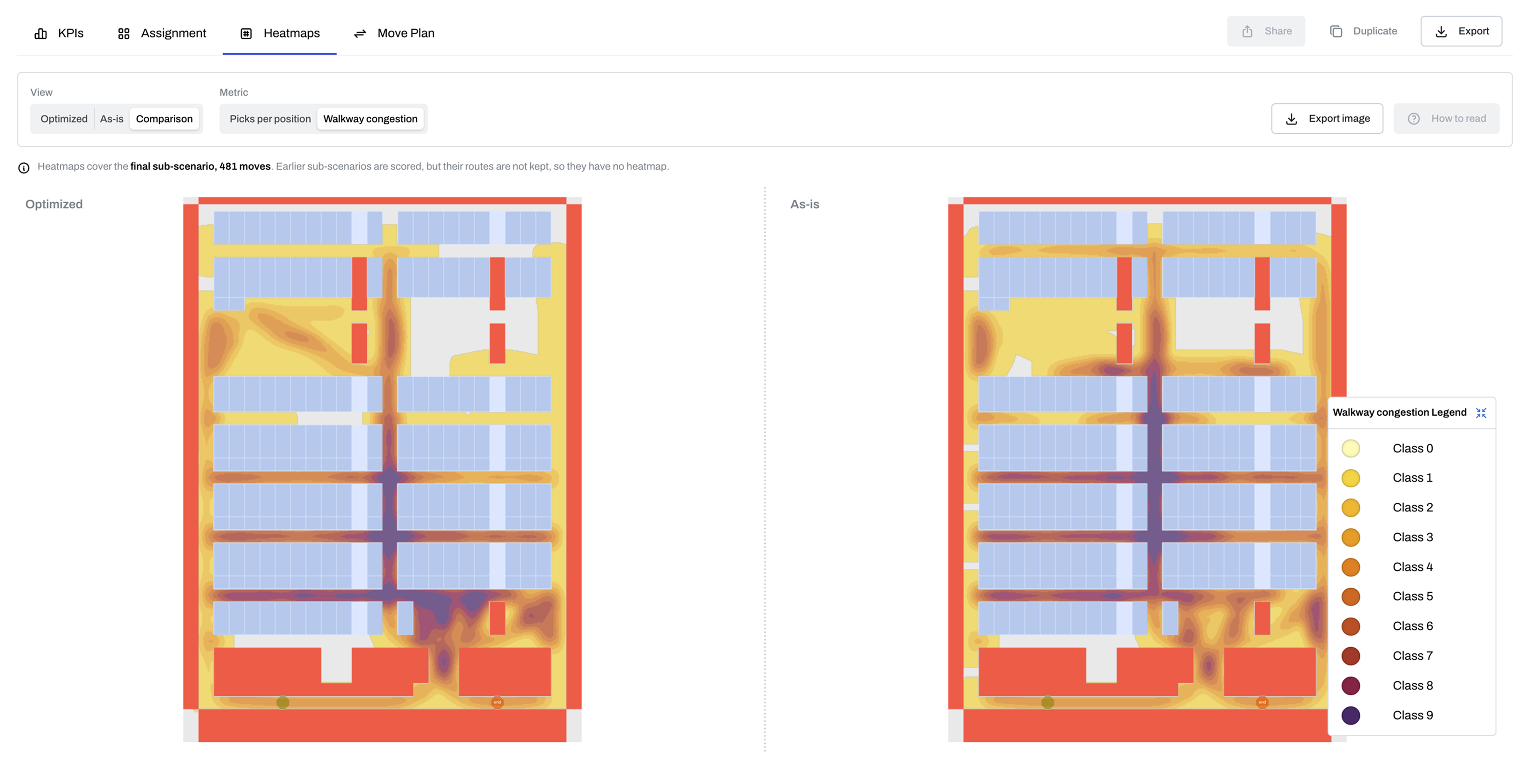
Analyze your congestion profile well before peak. If you make one congestion heatmap this year, run it now, while there is still time to do something about it.
Questions?
Picker blocking is time lost when one picker has to wait for another. It comes in two forms: in-aisle blocking, where a picker cannot pass a colleague stopped at a pick face, and pick-face blocking, where two pickers need the same location at the same time.
Pick-face blocking happens in wide aisles too.
Because pickers interfere with each other, and that interference does not scale linearly with volume. Research on narrow-aisle batch picking found that adding pickers makes order picking performance likely to decline because of blocking.
Volume rises in a straight line. Blocking does not.
No. Wide aisles remove in-aisle blocking, where one picker cannot pass another, but not pick-face blocking, where two pickers need the same location at the same moment.
Research on wide-aisle order picking systems found that pick-face blocking increases with the number of pickers regardless of aisle width.
Yes, in what it optimizes for rather than in method. Most slot plans weight picking walk distance highest, which is correct at normal volumes.
In peak, waiting time costs more than walking time, so the congestion objective should carry more weight and picks per aisle should be balanced on the peak forecast rather than trailing velocity.
Slotting first, because it is slow to change once peak has started and needs doing in September. Batching second, because which orders travel together decides how many pickers share an aisle. Wave release third.
Pick path last, because sequencing the walk inside a batch has the smallest impact of the four.